
Product Discovery Workshop
Build the right things, consistently.
A hands-on Product Discovery workshop that gives your team the mindset, methods, and habits to continuously explore opportunities, validate ideas, and deliver products that create real value - for customers and the business.
Let's talk →Assess your team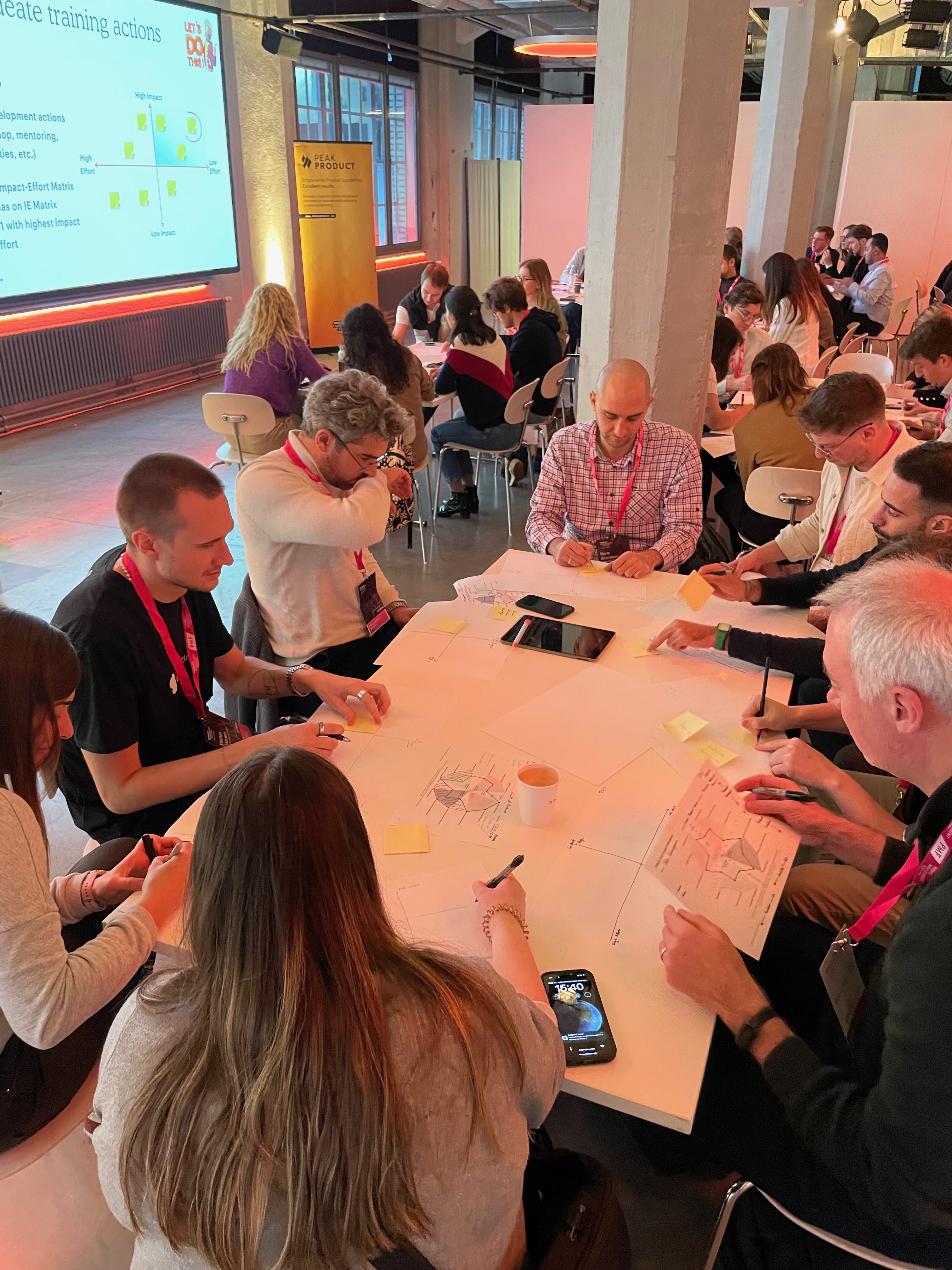
Worked with product teams at Syncron, desertcart, elyps, UX Pilot, FOUND, Taxfix, Deviniti and Bayer


What's Included
A dedicated 2-day workshop designed around your team's real product context - not a generic slide deck.
- Interactive, facilitated workshop (online or on-site) built around your actual product environment
- Tailored case study or real examples from your team's context - so learning transfers immediately
- Foundations of Product Discovery: what it is, why it matters, and how to embed it as a continuous practice
- Introduction to the Opportunity-Solution Tree (OST) and the 3W Loop as frameworks for structuring discovery work
- Translating business goals into outcome-based product goals - moving from output to outcome thinking
- Identifying and prioritizing product opportunities through research and structured discovery
- Ideation and solution design: turning opportunities into testable hypotheses
- Assumption mapping across Desirability, Viability, and Feasibility (DVF)
- Research and validation methods: in-depth interviews, story-based research, qualitative and quantitative synthesis
- Experiment design: Test Cards, Learning Cards, validation planning
- Post-workshop action report with recommended next steps and optional ongoing support
Common Problems We Solve
You are probably here because one of these sounds familiar:
Our Process
Scoping & tailoring
We start with a scoping call to understand your team's current discovery practices, the products you work on, and the challenges you want to address. This lets us prepare a tailored case study and shape the exercises around your real context - not a generic scenario.
Discover and Understand
We establish the foundations: the product development process, what discovery actually means in practice, and how to structure work with the Opportunity-Solution Tree. We then move into translating business goals into product outcomes, identifying and mapping opportunities, and exploring how research helps you make better product decisions.
Validate and Plan
We cover ideation and solution design, assumption mapping (DVF), and the most effective validation methods - from in-depth interviews to lightweight demand tests. The day closes with experiment design, where each team member leaves with a test plan for a real opportunity from their own work.
Action report & next steps
You receive a written action report with our recommendations on how to embed discovery practices into your team's rhythm, plus a roadmap for what to prioritize next. Optional ongoing support is available for teams who want continued coaching.
What You Leave With
Six things your team takes out of the two days, built on your own product. One running example shows what each looks like.
Why Choose Us
We work on your real product - not a fictional case.
Every exercise is designed around your team's actual context. The case study is tailored to your product. The outcomes are immediately applicable.
Hands-on, not theoretical.
We spend the majority of time on interactive exercises, not slides. Your team practices the methods in the room - so they can apply them on Monday morning.
Built for product organizations, not just startups.
This workshop is designed for teams in established or scaling companies where there is already a product function, but discovery practices need to mature.
An advisor who has built products, not just trained people.
Aleksander has built 4 tech products from 0 to 1 in fintech, HR, design, and analytics - and has trained over 300 startups and 20 product organizations. The workshop is grounded in what actually works in practice.
It builds a habit, not just knowledge.
The goal is not a one-time learning event. It's to help your team build a continuous discovery muscle - so that exploring and validating becomes part of how you work every week.
The Methods, on Real Products
The workshop teaches the methods we use in client work. What one participant said about the training, and three places the methods paid off.
"I recommend Aleksander to everyone who is looking to upskill in the product space"
"I was part of the Product Discovery training conducted by Aleksander for Syncron. Right from the start, the training became a focal point for triggering new thoughts on discovery. From learning to formulate product goals that are in sync with business goals, to identifying opportunities, ideating and then validating them, everything was conducted by Aleksander in a playful manner involving the team in group activities that stimulated learning."


FAQs
Who is this workshop for?
How long is it?
Can it be delivered online?
How many people can attend?
Do we need to prepare anything?
What do we leave with?
Should we do the workshop or ongoing coaching?
Service Area
This workshop is available for product teams across Europe and globally, delivered online or on-site. Aleksander is based in Wrocław, Poland and has worked with product organizations across Switzerland, Belgium, France, Hungary, UAE, and Poland. On-site delivery is available across Europe with travel costs included in the project quote.
Product Model Maturity Assessment
Before the call, see where your team stands.
Fifteen questions, about three minutes: your Maturity Index on screen and by email, with the three principles to improve first. A useful thing to have in hand before the intro call.
Assess your team- Delivery team
- Feature team
- Product team
- Product organization