
AI-First Product Teams
Decide faster, not just build faster.
One day for your product trios to redesign how they work with AI, on the work already on their plate. Then, if you want it, a 6 to 8 week sprint that measures what changed: how fast your teams learn, and which numbers move.
Book a free intro call →Assess your team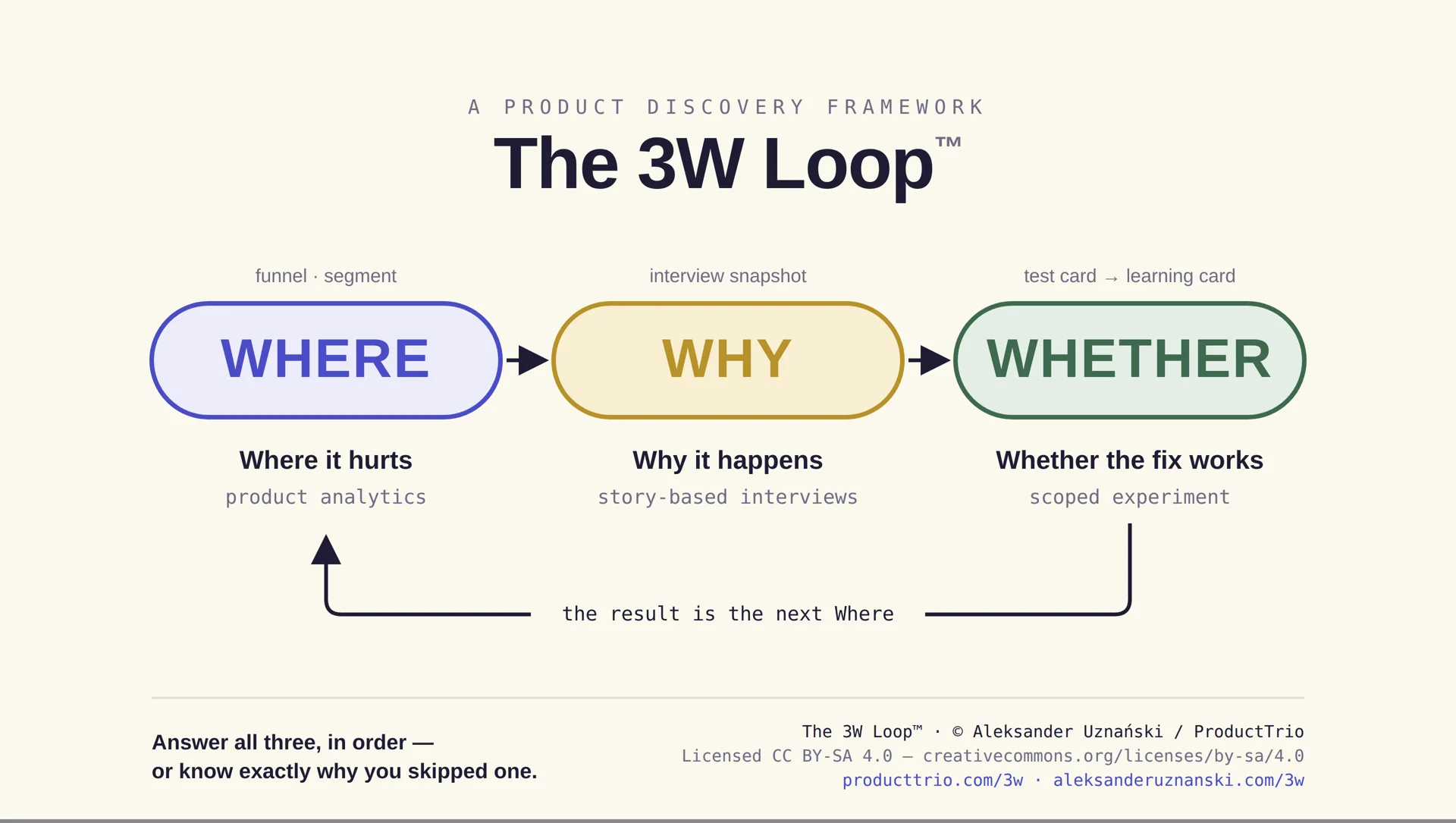
Worked with product teams at
- Deviniti
- UX Pilot
- elyps
- Taxfix
- FOUND
- desertcart
- Syncron
- Bayer
Why AI-First Stalls
Most product teams already use AI every day. Far fewer can show what it changed. Three reasons come up again and again:
What AI-First Means Here
AI-first does not mean fewer people. It means the people you have learn faster, and spend the time AI saves on deciding what is worth building.
Why We Are Running This as Founding Pilots
We have not published an AI-first result yet, and we will not borrow one. So this quarter we are running the workshop and the sprint with two product organizations as founding pilots, at a pilot price, and we will publish what we learn with their permission. Here is what the pilots build on:
Common Problems We Solve
If AI-first is your goal, some of these will sound familiar:
How It Works
Redesign the loop with AI, on live work
Your trios bring the work already on their plate. In the morning we map where AI fits at each step of the 3W Loop, from reading the data to synthesizing interviews to prototyping the fix, and where a human has to check it. In the afternoon each trio runs one real bet through the new loop. You leave with your team's working rules and a test card for every trio.
Baseline: measure before anything changes
We measure where you start: how long a question takes to become evidence, how many bets each trio tests in a month, and the product numbers those bets are meant to move. Without a baseline, an AI program can only ever report usage.
Bets every week, with AI in the loop
Each trio runs a bet a week: interviews synthesized the same day, prototypes in front of customers within days, the test card written before the result comes in. Weekly working sessions in the flow of work, and the rules updated as the team learns where AI helps and where it misleads.
Readout: what changed
A learning card for leadership: the baseline against the end of the sprint, which bets moved a product number, what AI sped up and what it did not, and the rules worth keeping. Then the next loop, already scoped, run by your team.
What's Included
- A map of your discovery loop with where AI helps at each step, and where a human checks
- Working rules for your trios: which data goes into which tool, who reviews AI output, and what counts as evidence
- A test card for every trio, on a real bet from its current work
- The 3W Loop AI kit set up in the AI tools you already use: Copilot, ChatGPT, Claude or Gemini
- Whole trios, not single roles: up to 16 people, online or on-site
- A baseline of learning speed and of the product numbers your bets target, taken before anything changes
- A bet a week per trio, with AI in the loop, on live work
- Weekly working sessions in the flow of work, with the rules updated as you learn
- A readout every two weeks for the leader who owns the outcome
- End of the sprint: a learning card with the numbers, the rules worth keeping, and the next loop scoped
What We Need From You
AI-first only works on real work. Before we start, we agree on five things:
- Whole trios: a product manager, a designer and an engineer or tech lead from each team taking part
- Live work: a bet each trio is already working on, not an exercise
- AI tools your company already allows for this work, even if only one. We work inside them, and your data stays with you
- Access to customers for interviews and prototype tests
- For the sprint, a product number each trio owns, and a leader who wants to see it move
FAQs
Which AI tools do we need?
Do you host our data?
Is this about cutting headcount?
How is this different from an AI course for product managers?
What if our teams barely use AI yet?
What do you measure?
What does a founding pilot cost?
Do we have to continue to the sprint?
Reading for AI-First Teams
Six field notes on the thinking behind this program:
Building got 10x cheaper. Building the right thing didn't.
AI collapsed the cost of shipping and left the cost of being wrong exactly where it was.
AI made everyone think they can do everyone else's job
PMs design, designers ship, engineers own product. Tasks moved. Accountability didn't.
Stop building MVPs. Build a prototype that answers one question.
Pick the prototype from the assumption, not the roadmap, and know when to build the real thing.
Are you a Product Builder or a Product Architect?
Ravi Mehta's 12 competencies split most PMs into two shapes, and the team version matters more.
Velocity isn't the point. The 4 product risks that sink launches.
Teams ship fast and still fail, because they efficiently build the wrong thing.
What is the 3W Loop? Where, Why, Whether
Three questions, asked in order, each with its own instrument.
Service Area
Designed for product organizations with several product teams that already use AI tools. Available remotely (global) and on-site across Europe. Aleksander is based in Wrocław, Poland.
Is your goal a specific number? Conversion and retention have their own pages: the Funnel Conversion Sprint and the Retention Diagnostic & Sprint.
Product Model Maturity Assessment
Before the call, see where your teams stand.
AI makes whatever your teams already do faster, so it pays to know what that is. Fifteen questions, about three minutes: your Maturity Index on screen and by email, with the three principles to improve first.
Assess your team- Delivery team
- Feature team
- Product team
- Product organization