Both fixes were tiny: two case studies from a discovery masterclass
I spent 90 minutes with a product management cohort on two real cases, a neobank and an AI design tool. The fixes took days. Finding where and why took the work, and that was the lesson I wanted the room to keep.
In October I ran a product discovery masterclass for the Autumn Cohort 2026 of Product Management Academy. Thanks to Tomasz Tomaszewski for the invitation, and to the group for the questions and a chat that never went quiet.
I did not want to teach discovery as a list of techniques. People forget lists. So we spent an hour and a half on two real cases from my own work, and ran each one through the same three questions.
Three questions, in order
The frame was my 3W Loop. Each W has its own instrument:
- Where it hurts: product analytics.
- Why it happens: story-based interviews.
- Whether the fix works: a scoped experiment.
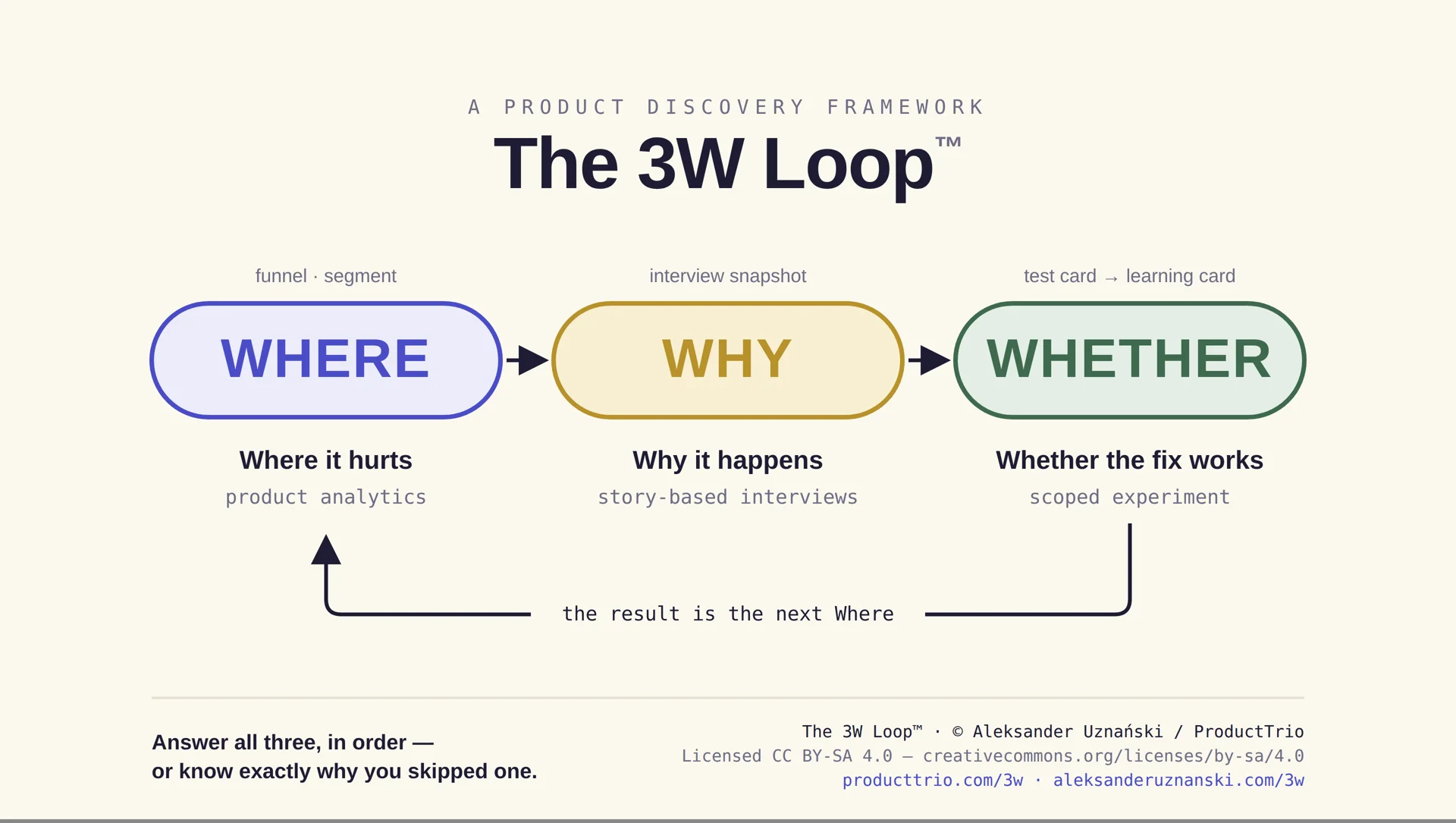
The order matters more than the tools. Most teams I meet start at Whether. They pick a fix, ship it, and then argue about whether it worked.
Case 1: elyps, and the screen where people left
elyps was a French-Belgian neobank. In 2020, 80% of the people who started onboarding never finished it.
Analytics answered Where. The drop-off was not spread across the funnel. It sat almost entirely on one screen, the one right before identity verification, telling people we would now scan their ID and their face.
The obvious read was that KYC is too much friction. But you cannot simplify a legal identity check, so that read leads nowhere.
Interviews answered Why. People opened their invite on the Paris metro, or at work. Nobody wants to pull out an ID card on the metro, or take a selfie in front of their boss. The problem was not the step. It was the moment.
The fix was a "Do it later" button and a push reminder at 8 pm, when people were home. Drop-off fell from 80% to 60%, and notification opt-ins went up as a bonus, because people finally had a reason of their own to say yes. The full method is in how to reduce onboarding drop-off without weakening KYC.
One participant guessed the Why before I showed a single interview finding. Good instincts in that room.
Case 2: UX Pilot, where I skipped the interviews
At UX Pilot, an AI design tool, the goal was free-to-paid conversion.
For Where, I compared free and paid cohorts by what they did in their first 7 days. Users who tried Deep Design converted at 12.3%. Users who did not: 1.3%.
This time I skipped Why on purpose. The fix was clear, cheap and reversible: turn Deep Design on by default for first-time users. Interviews would not have changed the decision to test it, so they would have cost time and told us nothing we needed.
The A/B test lifted free-to-paid conversion by 45%. I wrote down how to decide when skipping is the right call in interview first, or go straight to the test?
What I hope the group takes away
1. Both fixes were tiny. A button and a reminder. A default flipped on. Finding where and why was the work. I keep seeing this, and I wrote more about it in big problems rarely need big solutions.
2. Interviews are for exploring, not validating. Ask about the last time it happened, not about opinions. "Would you use a later button?" gets you a polite yes. "Tell me about the last time you opened the invite" gets you the metro.
3. Write down the success metric before the test starts. Otherwise, two weeks later, nobody knows if it worked, and the result becomes whatever the loudest person wants it to be. That is the whole point of a test you can fail.
4. Skip the Why only when the fix is clear, cheap and reversible. All three, not one of them. elyps failed that check: the obvious fix, simplifying KYC, was not even possible, and the real one only showed up in interviews. UX Pilot passed it.
Which W does your team skip?
Each skipped W leaves a different gap. Skip Where and you fix a step nobody struggles with. Skip Why without passing the three checks and you guess the reason. Skip Whether and you never learn if the fix worked.
If you want your team to practice the whole loop on its own funnel rather than on my cases, that is what the product discovery workshop is for.
So which one does your team skip most often?