Ask about the last time, not how they usually do it
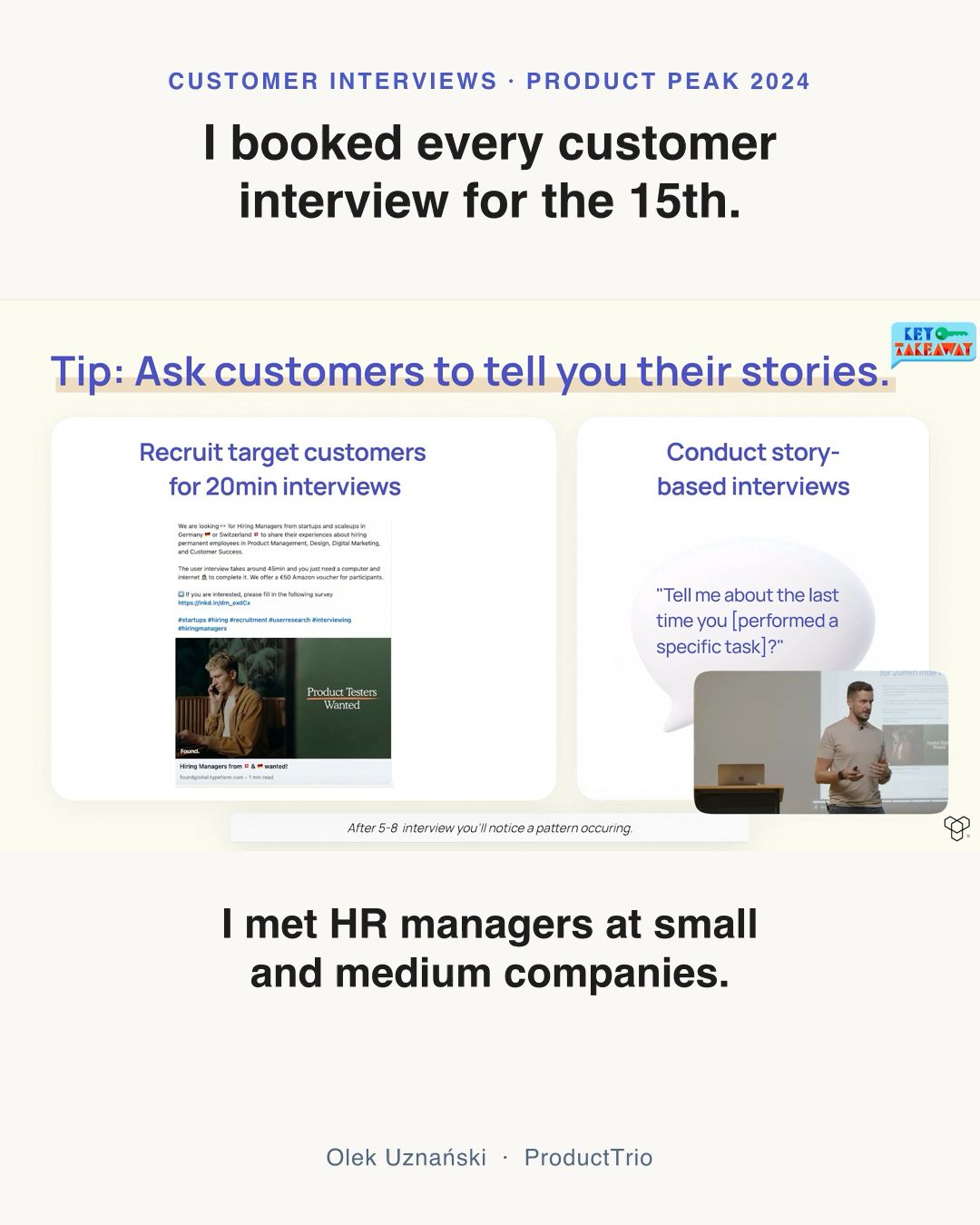
When I was building a payroll tool, I booked every customer interview for around the 15th of the month. The date was not an accident, and neither was the question I asked once we sat down.
It was 2022. I was building a payroll tool, and I was talking to HR managers at small and medium companies to find out what their month actually looked like.
Every interview went into the calendar for around the 15th. Here's why, and why I still pick the day before I pick the questions.
Why the 15th
The HR managers I was talking to close payroll on the 10th.
So on the 15th, it's still fresh. Five days after the close, they still remember what this month's run actually took. Wait a few weeks and it gets smoothed over into "it's fine, we have a process."
That smoothing is the enemy of a good interview. You want the messy version, and the messy version has a short shelf life.
The question that changes the answer
I didn't ask "how do you do payroll?"
I asked: "You just finished September's payroll. Can you walk me through it?"
Those two questions sound close. They get completely different answers.
The first one invites a description of the process. The second one asks for a story about a specific time, with a beginning, a middle and an end. People can't tell you that story without telling you where it went wrong, who they had to chase, and what they did to work around it.
Handbook versus what happened
Here's the rule I keep coming back to.
General questions get you the process from the handbook. Specific ones get you what actually happened.
The handbook version is how the person thinks the work is supposed to go, or how they would explain it to a new hire. It's tidy. It's also mostly useless for product decisions, because the problems you could solve live in the gap between the handbook and the real month.
What actually happened is where that gap shows up: the extra steps, the workarounds, the part that never makes it into the official process. That is the raw material for an opportunity, and you only get it by anchoring the conversation to one real, recent instance.
It's the same reason "would you use this?" is a weak question. I made the longer case in talk to five customers this week: stories about real, recent behavior are data, opinions about the future are noise.
How many you need
You don't need 30 of these.
Usually, 5 to 8 interviews with a well-defined persona is enough for the pattern to show up. By then you start hearing the same workaround described in different words, and the next conversation adds less than the last one.
The condition matters, though. "Well-defined persona" is doing a lot of work in that sentence. If you mix small-company HR managers with enterprise payroll teams, the stories won't line up, and you'll need many more conversations to see anything. Pick one group first, then go find more of them.
For a worked example of what a handful of conversations can change, here's what nine interviews actually changed on a product with a million users.
Find your 15th
Payroll was just one example. Whenever I build a product, I follow the same approach when talking to customers: I ask about the last time they did the job, not how they do it in general.
The date trick is the other half. Most jobs your product touches have a rhythm: a monthly close, a weekly report, a quarterly review, a booking season. Find out when the job happens, and book the interview shortly after, while the last time is still the last time and not a blur of all the times.
This is the Why step of the 3W Loop: analytics tells you where users struggle, and story-based interviews tell you why. If you want your team to run these conversations every week, not once a year, that's what the Product Discovery Workshop sets up.