When anyone can build, understanding users is the edge
AI is commoditizing software the same way YouTube commoditized video creation 20 years ago. Video skills didn't stop mattering, but the best equipment mattered less than the best content. The same shift is now happening to products.
AI is commoditizing software the same way YouTube commoditized video creation 20 years ago.
I keep coming back to that comparison, because it explains something the "AI will replace engineers" debate misses. When a skill gets commoditized, it does not stop mattering. What changes is which skill decides who wins.
What happened to video
Before YouTube, making video that anyone would watch required equipment, a studio, and access to distribution. The barrier was technical and financial. If you had the camera, the editing suite and the broadcast slot, you were most of the way there.
Then anyone could film and publish.
Video skills didn't suddenly stop mattering. Lighting, sound and editing still separate good from bad. But the best equipment mattered less than the best content. The channels that won were the ones that understood exactly who they were making videos for, and gave that audience something they actually wanted to watch.
The same thing is happening to products
I think the same shift is happening with software, and faster.
The technical gap between teams is shrinking. A small team with AI tooling can now build what used to need a much bigger one, and a competitor can copy your feature set far faster than before. "We have better engineers" was a moat for a long time. It is getting shallower every month.
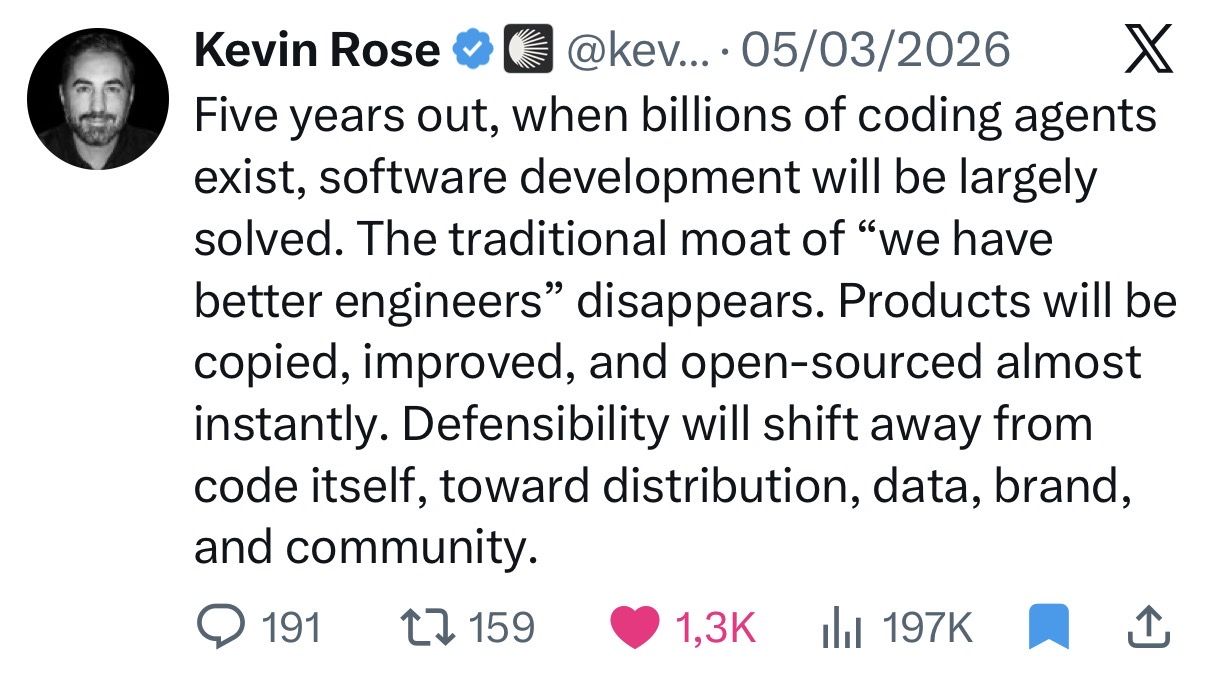
Kevin Rose made a version of this argument on X: once coding agents are everywhere, the traditional moat of better engineering disappears, products get copied almost instantly, and defensibility moves toward distribution, data, brand and community.
I agree with the first half completely. Where I would add something is the list.
The gap that will get bigger
While the technical gap shrinks, another gap is going to grow: the one between teams that deeply understand their users, and teams that don't.
The products that win won't necessarily be the most technically perfect. They will be the ones that solve a real problem for a specific audience, in the most valuable way. That is not a sentence about code. It is a sentence about knowing who your audience is, which problem actually hurts them, and what "valuable" means to them rather than to you.
That knowledge is hard to copy. A competitor can clone your interface in a weekend. They cannot clone two years of conversations with your customers, or the instinct a team builds from watching people struggle with the real problem. Gibson Biddle's test for a strategic bet asks exactly this: is it delightful, hard to copy, and margin-enhancing? Deep user understanding is one of the few things that scores on the middle one.
That's why product discovery matters more now, not less.
Distribution and community still need something worth talking about
When I shared the YouTube comparison, I asked what people think will become the real differentiator as building software gets easier. Discovery, distribution, community building?
My honest answer: all three matter, and they are not independent.
Distribution is a real advantage. So is a community. But both amplify whatever you have. Distribution gets a product that solves nothing in front of more people who will leave. A community forms around something people already care about, and it rarely forms around a feature list.
Most YouTube creators who ended up with the best distribution didn't start with it. They started with content a specific audience wanted, and the audience became the distribution.
For products, that content is the value. And you only find the value by understanding the user before you scale the reach.
What this means for how teams work
If the edge is moving from building to understanding, the team's time has to move with it.
Three shifts I would make in almost any team right now.
Spend the saved build time on learning, not on more building. When AI cuts a feature from three weeks to three days, the temptation is to ship five more features. The better trade is to spend part of the saved time making sure the next one is worth shipping. Roughly 80% of features are rarely or never used, and producing them faster does not change that ratio.
Narrow the audience before you widen the product. "Everyone who manages a team" is not an audience. A specific segment with a specific, painful problem is. Teams that win usually iterate on who before they iterate on what.
Stop copying the competition. When building is cheap, copying is cheap too, which means a copied feature is no advantage at all. Your competitor's roadmap is a record of their guesses about their customers. I made the longer case in stop copying your competitor's roadmap.
I covered the cost side of this, why cheap building makes wrong bets more expensive rather than less, in building got 10x cheaper, building the right thing didn't. This post is the competitive side. When everyone has the same tools, the team that knows its users best is the one with the edge.
Finding the few bets where your understanding of the user is genuinely hard to copy is what Product Strategy Consulting is for.