A working product on day one is not progress
This spring, every team in Steve Blank's entrepreneurship class showed up on day one with a working product built with AI. It looked like incredible progress, right up until they started talking to customers.
"AI had set our class on fire and would burn it to the ground." Steve Blank wrote that about his own entrepreneurship class, and I had to smile at the story behind it.
For fifteen years his Lean LaunchPad course has followed the same rhythm. Teams arrive with a business idea, talk to 10 to 15 customers a week, and reshape the idea every week based on what they hear. By week 10, the good teams have something that looks like a product.
This spring, every one of the eight teams showed up on day one with a working product.
At first, that looked like incredible progress. Then they started talking to customers. The product was ready. Their understanding of the problem wasn't.
What actually went wrong in the class
Blank's write-up, The Year AI Came For Us, is worth reading in full, because the teaching team is honest about falling for it themselves. A few things stood out to me.
The progress was phantom. A polished product on day one looked like evidence. It wasn't. It was a guess with a nice interface, and the teaching team was impressed enough not to refocus the students fast enough.
The ideas froze. Pivoting was technically cheaper than ever. But it became psychologically expensive. Teams that had already "built the thing" could not let go of it. Blank notes that teams before AI typically pivoted three or four times during the course. This cohort fought every change.
The learning got skipped. Some students used AI to summarize their interviews, and then could not defend their own assumptions or explain the edge cases their customers had raised. Blank calls it learning debt. Everything looked like evidence and wasn't, which he calls evidence theater.
The trap for founders right now
I think this is the trap for founders right now. When building gets this easy, it is tempting to ship continuously and treat the shipping as validation.
It isn't. A much faster way to get to product-market fit is doing discovery first: talking to your customers and testing your assumptions before you commit to a build.
The objection I always hear is that building is now so cheap you might as well just build and see. I answered that in detail in building got 10x cheaper, building the right thing didn't. The short version: the cost of producing a feature collapsed. The cost of being wrong did not.
Blank's class adds a cost I had underrated. Once you have a working product, you are attached to it. The cheapest moment to change your mind is before anything exists, and AI makes it very easy to skip that moment entirely. And when every competitor has the same tools, building is no longer the edge anyway: understanding users is.
The bottleneck moved
The most useful line in Blank's after-action review, for me, is the diagnosis. The bottleneck moved from how fast you can build to judgment about what to build, and for whom.
His team also concluded that the MVP no longer counts as evidence of customer discovery or product-market fit. For years, a working product at least proved a team had done the work to get there. Now it proves the team had access to a tool.
That changes what a founder, a coach or an investor should be asking to see. Not the demo. The learning behind it.
How to tell a team that is learning from one that is shipping
This is the question I asked when I shared Blank's story, and it is the one I would ask about any team, AI or not. A few signals I look for.
They can name what the last build was testing. Not what it does. Which assumption it was meant to prove or kill. If nobody can say, it was shipping, not learning.
They wrote down what success looks like before they ran it. A threshold, a date, a metric. Write it afterwards and a test you cannot fail is a demo.
They have changed their mind recently. Blank's three or four pivots per course is a useful benchmark. A team that has not changed anything important in months is either very lucky or not listening.
They can tell you the last customer conversation themselves. In their own words, with the specific moment the customer described. Not a summary a tool produced. That is the whole point of talking to five customers this week: the learning happens in your head, not in the transcript.
They know how strong their evidence is. "Users loved it" and "12 of 15 users came back the next week without a reminder" are not the same kind of claim. I use Itamar Gilad's Confidence Meter for this, as I explain in how strong is your evidence.
The slide I show at the start of every workshop
I open almost every workshop and engagement with the same data, because it shows how often founders build without evidence, and how much discovery changes the odds.
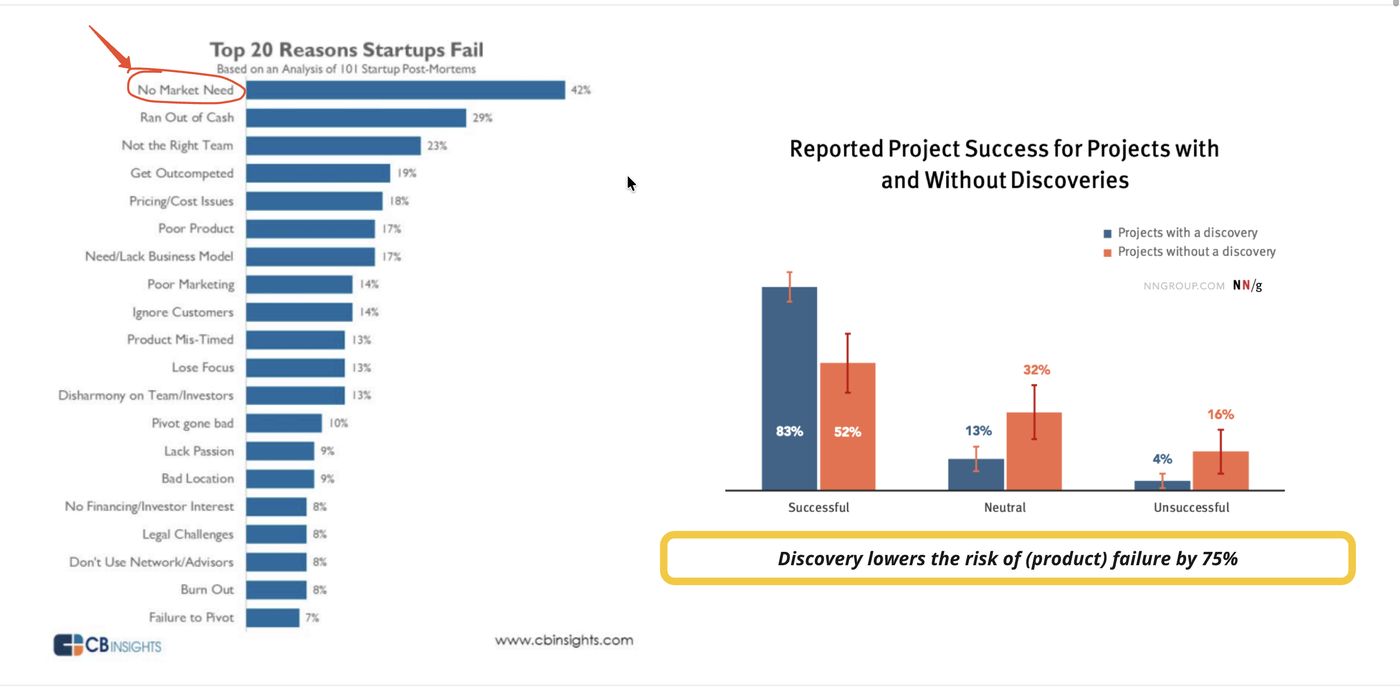
Projects with a discovery phase reported success 83% of the time, against roughly a coin flip without one. Discovery lowers the risk of product failure by about 75%. Those numbers were true before AI, and nothing in Blank's class suggests they have changed. If anything, a team can now reach the "no market need" bar on the left much faster.
Getting founders to do the discovery part first, before the working product, is what the 0 to 1 Product Development Workshop is for. The working product can wait a week. The understanding can't.